Collagen and tissue remodeling
Collagen production seemed the obvious attraction when I opened this collection. The wider repair machinery turned out to be more absorbing.
The collagen experiment
In the 1988 human fibroblast culture study, GHK-Cu stimulated collagen synthesis independently of a change in cell number. The researchers had separated increased collagen production from simply having more cells in the dish.
I admire that small piece of experimental housekeeping. It gives the result a useful shape: the cells changed their collagen-making activity. A claim about an increase becomes more informative when its obvious alternative explanation has been examined.
The setting remains a culture of human cells. There is no face in this experiment, no assessment of how a cream feels, and no observation of how long an appearance lasts.
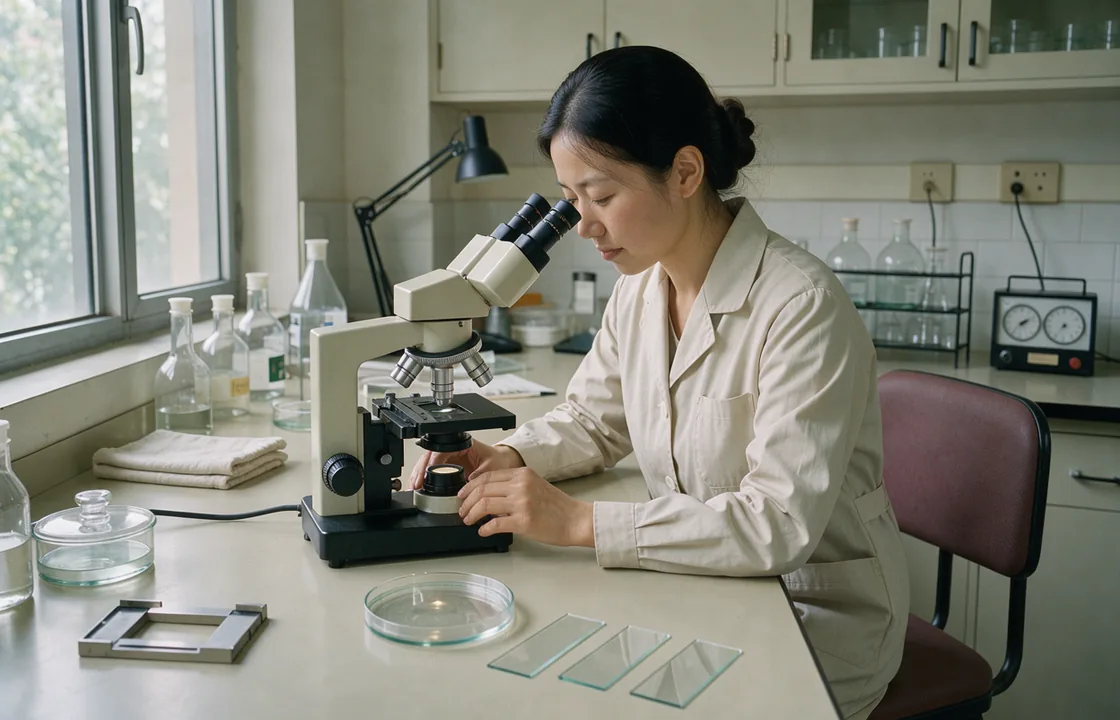
The repair machinery
The tissue-remodeling review describes increased production of collagen, elastin, metalloproteinases and anti-proteases across the studies it discusses, alongside effects involving growth factors and repair cells. It reviews human and animal work, with routes and study conditions varying across that work.
The range matters to the preservation idea. The extracellular matrix is the supporting material around cells; remodeling involves changes to that material. For me, the possibility of a coordinated repair process has more appeal than a pile of extra collagen.
That is an interpretation of the review's breadth. The reviewed models still have to be considered individually. A catalogue of activities gives the repair question more detail while leaving the translation of each activity into a particular human result to be established.
Materials around the cells
The skin-regeneration review also describes synthesis of dermatan sulfate, chondroitin sulfate and decorin alongside collagen. These are components associated with the tissue matrix. The vocabulary is less familiar than collagen, but it widens the picture of what a repair process might involve.
That crowded material world suits the conservation room. A surface's appearance can be the most visible part of a much more intricate subject. Actual materials and cellular tasks are more absorbing than a tidy beauty phrase, to my taste.
The appeal is intellectual. The presence of those materials in a mechanistic account cannot by itself choose a preparation or predict a face.
Repair and preservation
The analogy works for me because preservation involves active work. An appearance can persist through change; a living tissue makes that idea more interesting than a permanently polished surface.
The culture experiment began with a defined collagen-synthesis result. The reviews expand the collection without making every finding interchangeable. For the ambition to preserve something much larger, the next room contains gene-expression research and the plasma-age comparison.